Documentation
Introduction
The Declarative Skill Setup & Orchestration Engine.
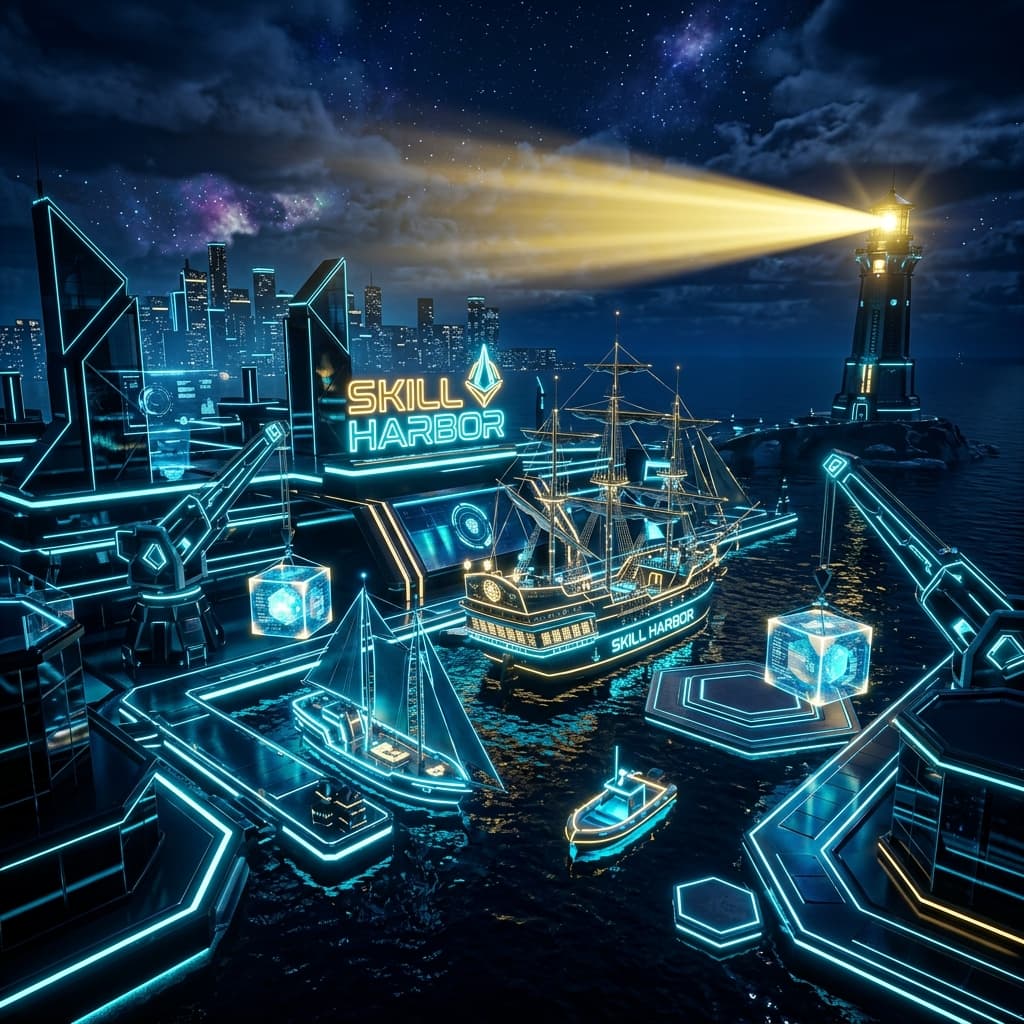
⚓ Skill Harbor ⚓
Instead of manual skill installation or fragile global configurations, Skill Harbor uses a declarative manifest to manage your team's "Collective Intelligence." It enables individuals and teams to gain deep insights into their skills, hone them for specific projects, and orchestrate their distribution seamlessly.
It is the intelligence infrastructure layer for professional development workflows.
🧭 Manifest-First
Skill Harbor is driven by a committed .harbor/harbor-manifest.json that defines which skills your project manages and where they should be berthed.
🧭 Sources vs Targets
Learn the difference between where skills come from, where Harbor generates them to, and how folder-backed sources like ~/.rulesync/skills fit into the model.
⚓ Dock + Up
skill-harbor dock registers a skill source. skill-harbor up is the core engine that fetches sources, runs target-specific adaptation, and berths skills into agent folders.
🛳️ Multi-Target Berthing
During skill-harbor up, one manifest can deploy consistent skill context to Claude, Cursor, Codex, Gemini, Windsurf, Copilot, and other supported targets.
🧱 Skills-First Architecture
Skill Harbor stays focused on skills: fetch, refine, govern, and berth them well without expanding into every other config surface.
🛡️ Governance Controls
Use up --lockdown, stow, unstow, undock, and migrate to control what agents can see and to safely manage state over time.
📏 Analysis + Verification
fathom audits token load, contracts, and ghost skills. voyager simulates agent workflows. check validates berthed skill metadata.
📊 Benchmarking
Learn how Skill Harbor approaches benchmarking: Voyager for empirical scenario evaluation, Fathom for predictive audit and fleet analysis, and Harbor as the operational layer connecting both.
👻 Ghost Governance
Learn what Ghosts are, use the new skill-harbor ghosts workflow, and understand how ghost inspection relates to Fathom, Voyager, stowage, and managed sources.
🕯️ Agent Discovery
lighthouse generates a fleet-intelligence snippet for agents that do not natively discover berthed skills on their own.
🏗️ The Harbor Workflow
Basic Workflow
graph TD
    Workspace[Your Project] -. "Add new skill" .-> Dock[⚓ skill-harbor dock]
    Workspace --> Up[⚙️ skill-harbor up]

    Dock --> Up
    Up --> Use([Skills Available to Agents])

    subgraph "Intelligence & Verification"
    Use --> Light[🕯️ skill-harbor lighthouse]
    Use --> Fathom[📏 skill-harbor fathom]
    Use --> Voyager[⛵ skill-harbor voyager]
end🏆 Skill Standards
At the heart of the harbor is the Skill Standard. We believe that AI context shouldn't be a "black box." Every skill in your fleet follows a strict anatomy centered on:
- Strategic Headers:
Purpose,Trigger, andGuidelinesfor deterministic routing. - Semantic Contracts: Optional
RequiresandProduceskeys to allow for safe skill chaining. - Displacement Math: Automated token counting to keep your "context wake" small.
Harbor is intentionally skills-first. For the architectural boundary behind that decision, see Architecture & Product Boundary.
🧠 The Necessity of Curated Registries
Empirical research suggests that LLMs cannot reliably self-generate procedural knowledge on the fly. In the SkillsBench evaluation, self-generated skills produced negligible or negative benefit on average. Skill Harbor addresses that failure mode by providing a vetted catalog of strategic skills, making a curated registry a safer operating model for reliable agent success.
If you want the deeper comparison, see the FAQ entry: How does Skill Harbor align with SkillsBench?.
🔍 What This Looks Like in Practice
A new developer joins your team. Without Skill Harbor, they spend time manually copying prompt files into .claude/skills/, hoping they grabbed the right versions, and have no idea which skills their teammates are using.
With Skill Harbor, they clone the repo and run one command:
skill-harbor upThat single command reads the committed .harbor/harbor-manifest.json, fetches the latest versions of every skill, adapts them for each agent platform (Claude, Cursor, Codex), and berths them into the right configuration folders. Every developer on the team now has identical agent context.
Later, a tech lead wants to verify the fleet before merging a PR that adds a new skill:
# Does the new skill bloat the context window?
skill-harbor fathom --report --max-tokens 15000

# Do the I/O contracts between skills still align?
skill-harbor fathom --contracts

# Does the agent actually use the right tools for this query?
skill-harbor voyager -f harbor-voyager-test.yamlIf any check fails, the process exits with code 1 — ready to block CI.
⚓ Why You & Your Team Benefit
Skill Harbor is built for the Solo Captain and the Full Fleet Command.
🚢 For Teams (Fleet Command)
- The Synced Brain: Commit a
harbor-manifest.jsononce, and every developer gets the same specialized skills and context instantly. No more "Works on my machine" agent behavior. - Collaborative Governance: Enforce strict
--lockdownrules and semantic contract validation across your entire repository. - Atomic Standardization: Ensure all agents (Claude, Cursor, Codex, Antigravity) are playing by the same set of maritime rules.
🚣 For Individuals (Solo Captains)
- Skill Honing: Use the Loft Master and Fleet Surgeon to right-size and refactor your personal skills for maximum performance.
- Context Insights: Understand exactly how much "displacement" (tokens) your skills are consuming and avoid reasoning degradation.
- Global Fleet: Manage a persistent user-level manifest to sync your personal brand of intelligence across every project you touch.
✨ Features at a Glance
- 🚣 Insights & Refinement: Mathematically audit your intelligence layer for token bloat and semantic collisions with Fathom.
- 🚢 Enterprise Skill Sync Engine: Standardize AI context rules for your entire repo.
- 🏗️ Multi-Platform Support: Automatic distribution to Claude Code, Cursor, Codex, and Antigravity.
- ⚡ Parallel Synchronization: Sync your entire fleet of skills concurrently for maximum performance.
- 🌍 Global Fleet Control: Manage personal and organization-wide skills across any project workspace.
- 🛠️ Cross-Platform Transpilation: Powered by
skill-porterto convert skill formats between Gemini and Claude seamlessly. - 🔌 Idempotent: Run
skill-harbor upsafely to pull down the latest adapted skill updates.
❓ Related FAQ
- Benchmarking Overview
- Voyager vs Fathom
- How does Skill Harbor align with SkillsBench?
- Why Not Skills.sh?
- Why Not Agent Skill Harbor?
Reference: Li, X., et al. (2026). SkillsBench: Benchmarking How Well Agent Skills Work Across Diverse Tasks. https://www.skillsbench.ai/skillsbench.pdf